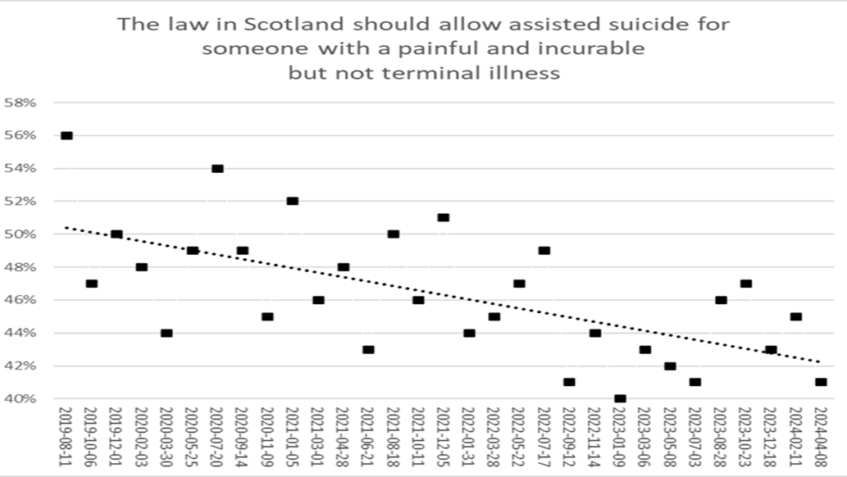
This graph shows how support for assisted suicide in Scotland has declined since 2019
Decline in support for assisted suicide in Scotland
An article in the Journal of Medical Ethics shows that support for assisted suicide in Scotland has dropped significantly.
Three polls conducted by the pro-assisted suicide group Dignity in Dying Scotland found that the number of Scots who “strongly supported” legalising assisted dying fell from 55% in 2019, to 45% in 2023, and to 40% in 2024.
A similar pattern was seen in a YouGov bimonthly trackers which asked the same question 31 times over five years: “Do you think the law should or should not be changed to allow someone to assist in the suicide of someone suffering from a painful, incurable but NOT terminal illness?” By April 2024 agreement had decreased to 41%.
A press release by the Anscombe Bioethics Centre, Oxford, states: “People might imagine that Liam McArthur’s Assisted Dying for Terminally Ill Adults (Scotland) Bill would apply only to people with a terminal illness, but in fact the Bill makes no reference to being close to death. It would cover anyone with an advanced progressive condition that would be expected to shorten life if not treated. This would include long term chronic diseases like diabetes. Many people would not think of these as terminal illnesses.”
The Anscombe Centre also states that another opinion poll in March 2024 “found that only 47% of Scots wanted their MP to vote to change the law. That figure dropped to 26% among Asian and 16% among Black cohorts. Other surveys demonstrate that when the Scottish public were asked about their top concerns, assisted suicide or assisted dying did not register. It is simply not a priority for voters.”
It is rightly asserted that, once a law allowing assisted suicide is established in a country, it will become a slippery slope and the law will quickly be expanded and so-called ‘safeguards’ eroded. But in the case of this Bill, we are already halfway down the slope as it instantly applies to people who do not have a terminal illness. And it will not be long before other conditions are included. In countries where assisted suicide and/or euthanasia is already legal, eligibility criteria has been expanded to include people with arthritis, anorexia, autism, and dementia. And also, children, including babies under one year old with Spina Bifida.
Assisted suicide sends a devastating message to vulnerable people that there are situations when suicide is an appropriate response to individual circumstances, worries and anxieties; normalising suicide and accepting that some people are beyond hope.
Furthermore, assisted suicide undermines trust in doctors and damages the doctor-patient relationship. And in countries where assisted suicide is legal, there is evidence that vulnerable people, including the elderly and disabled, experience external pressure to end their lives, for fear of being a burden on family, caregivers, and the state.
When vulnerable people, including the elderly, poor and disabled, express concerns about being a burden, the appropriate response is not to suggest that they have a duty to die; rather, it is to commit to meeting their needs and providing the care and compassion they need to help them live.
It is little wonder that support for assisted suicide drops once the reality of the proposals are exposed.
Please contact your MSPs today to warn them about the dangers of legalising assisted suicide in Scotland, and to urge them to vote against the Bill. Full details, including guidance on how to contact your MSPs, here: Assisted Suicide – Catholic Parliamentary Office (rcpolitics.org)
If the issues discussed here affect you or someone close to you, you can call Samaritans on 116 123 (UK and ROI), visit their website or contact them on: [email protected]