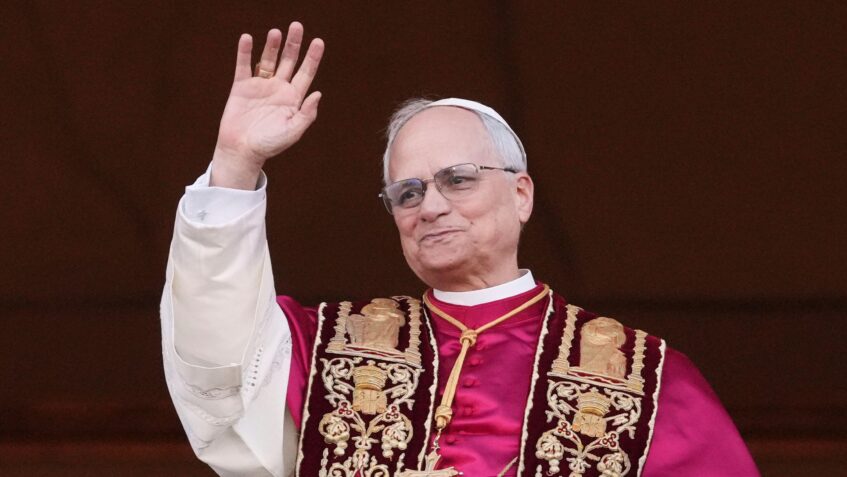
Image: Associated Press/Alamy Stock Photo
Pope Leo XIV on Peace, Synodality, and Building Bridges
This article is based on the first of a two-part interview between Pope Leo XIV and Elise Ann Allen, a Crux Senior Correspondent, for her new book “Leo XIV: Citizen of the World, Missionary of the XXI Century.”
In the conversation, Pope Leo reflected on his papacy, his unique identity as both US-born and Peruvian, and his hopes for the Church and wider world.
In response to Allen’s question about his background, Pope Leo emphasised that both dimensions shape his ministry: “I’m obviously an American and I very much feel that I’m an American, but I also love Peru very much… Half of my ministerial life was spent in Peru, so the Latin American perspective is very valuable to me,” he explained. He added that his time in Latin America helped him appreciate the vision of Pope Francis and strengthened his belief in the Church’s prophetic mission for today.
Understanding the Papacy
When asked how he understands his role as pope, Pope Leo admitted that the early months have been both challenging and formative. “There’s still a huge learning curve ahead of me,” he said. While the pastoral dimension came naturally, the responsibilities of global leadership were less familiar. “I had to jump in the deep end of the pool very quickly.”
At its core, however, he described the papacy in spiritual terms: “Being pope, successor to Peter, asked to confirm others in their faith… is also something that can happen only by the grace of God. The Holy Spirit is the only way to explain, how did I get elected to this office, to this ministry?”
Can the Vatican Be a Mediator?
Turning to global conflicts, Allen asked how realistic it is for the Vatican to serve as a mediator in Ukraine. The Holy Father distinguished between the Vatican’s role as a voice for peace and the practicality of acting as a mediator. “I’d make a distinction in terms of the voice of the Holy See in advocating for peace and a role as mediator, which I think is very different and is not as realistic as the first one,” he replied.
Even so, he insisted that the Church must never abandon hope. “We keep hoping. I believe strongly that we cannot give up hope, ever. I have high hopes in human nature,” he said, stressing that Christians must continue to call for peace and remind the world that alternatives to violence exist.
Polarisation and Building Bridges
Asked about the bridges he hopes to build politically, socially, culturally and within the Church, Pope Leo identified dialogue as the essential path. He noted that international institutions, such as the United Nations, often struggle to unite nations, but he emphasised the importance of both bilateral and multilateral efforts.
He also addressed the dangers of polarisation, which he said worsens divisions and harms societies. “We have to continue to remind ourselves of the potential that humanity has to overcome the violence and the hatred that is just dividing us more and more,” he observed.
When discussing polarisation, Pope Leo identified economic inequality as one of its root causes. He noted that the gap between ordinary workers and the wealthiest has widened dramatically over recent decades: where company leaders once earned only a few times more than their employees, today they can earn hundreds of times as much.
“The last figure I saw, it’s 600 times more than what average workers are receiving,” he said, adding that the recent news of Elon Musk potentially becoming the world’s first trillionaire illustrates the imbalance. “If that is the only thing that has value anymore, then we’re in big trouble.”
For Pope Leo, such inequality erodes the value of human life, family, and society itself. He stressed that if these deeper values are lost, “what matters anymore?”
Synodality as an Antidote to Division
On the subject of synodality, Pope Leo XVI defined it as “an attitude, an openness, a willingness to understand.” He explained that everyone in the church has a role to play in prayer, reflection and dialogue.
He acknowledged that some clergy fear it could undermine authority, but he rejected that view. “That’s not what synodality is about,” he said. Instead, it is about becoming a community that walks together and seeks communion. “It’s an attitude which I think can teach a lot to the world today,” he added. For Pope Leo, synodality is not only a way of renewing the Church but also an antidote to polarisation in wider society.