The UK is Destroying Itself in the Name of ‘Freedom’
John Paul II, in his encyclical, Evangelium Vitae (Gospel of Life), predicted that the weak and vulnerable would be sacrificed in the pursuit of greater autonomy for the strong and powerful
Over the last couple of weeks, MPs in the UK Parliament have voted in favour of decriminalising abortion and legalising assisted suicide. The effect of the former is to permit abortion up to birth for any reason; the effect of the latter is to cross a Rubicon and change healthcare forever by permitting doctors to help patients kill themselves.
In Scotland, politicians are treading a similar path: MSPs recently voted to take more time to consider an assisted suicide bill in Holyrood, and the Scottish Government has commissioned a working group to review abortion law. A working group that, despite being 13-strong, fails to include a single pro-life voice. Moreover, the group has agreed to a principle of non-regression as regards the law (i.e. the law must not be ‘weakened’) and is expected to recommend decriminalisation and thus, abortion up to birth, in Scotland.
These are devastatingly dark times for the UK. But is it in the least bit surprising?
Pope John Paul II, in his encyclical Evangelium Vitae (translated as Gospel of Life) published three decades ago, could see this coming.
John Paul foretold of a significant contradiction in the name of ‘human rights’ coming down the road; where those in power would seize upon its language, manipulate it, and in a perverse twist, use it to attack humanity, especially at the beginning and end of life.
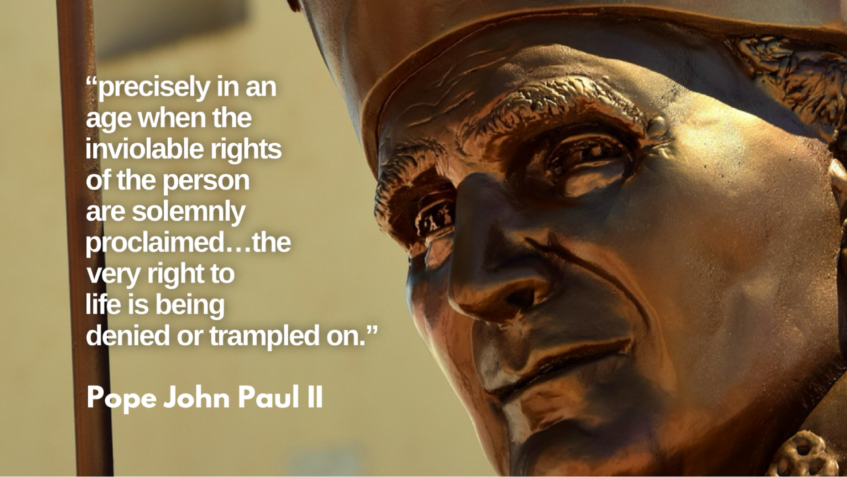
“Precisely in an age when the inviolable rights of the person are solemnly proclaimed and the value of life is publicly affirmed”, wrote John Paul, “the very right to life is being denied or trampled upon, especially at the more significant moments of existence: the moment of birth and the moment of death.”
The pope remarked that, whilst on one hand, there is a growing global sensitivity to human rights, an acknowledgement of the value and dignity of every individual as a human being, and even boasting on the part of politicians about their commitment to the protection of human rights, he astutely observed that there also exists a tragic repudiation of them in practice.
John Paul described this repudiation of human rights as a “scandal” and one which presented a direct threat to the entire culture of human rights and a peaceful democratic coexistence. He lamented that, rather than societies of “people living together”, our cities risk becoming “societies of people who are rejected, marginalised, uprooted and oppressed.”
The roots of this remarkable contradiction on human rights, according to John Paul, is taking subjectivity, or autonomy, to the extreme. This extreme creates fertile ground for a notion of freedom which “exalts the isolated individual in an absolute way, and gives no place to solidarity, to openness to others and service to them.”
It is, said the pope, “freedom of the strong against the weak who have no choice but to submit.”
John Paul believed that this freedom of the strong against the weak would eventually mean that there would be no place in the world for anyone who “like the unborn and the dying” is “a weak element in the social structure, or for anyone who appears completely at the mercy of others and radically dependent on them”, and who can only communicate through the “silent language of a profound sharing of affection.”
So many politicians and civic leaders loudly proclaim their support for solidarity, yet this support is evidently limited. In the case of far too many this support fails to extend to those who are unable to communicate at all (the unborn), or at least communicate adequately (the elderly, disabled, those who experience mental ill-health), for themselves. These are the weakest members of our society, the ones in most need. It is to these that politicians owe the greatest debt of the highest protection of the State. And yet this is not so. Indeed, the opposite is true. Our politicians are collectively failing these people and not giving them the protection that their human dignity, weakness and vulnerability deserve.
In other words, those unable to speak for themselves are abandoned by the very people who ought to be protecting them. The ‘freedom’ that today’s civic leaders legislate for, apply, and roundly applaud, including those in the name of ‘reproductive rights’ and ‘assisted dying’, utterly fails the most vulnerable in our society. Moreover, this ‘freedom’ negates and destroys itself because it leads to the destruction of others. It is not freedom, but a war on the vulnerable.
Pope John Paul warned governments that, if the promotion of self is understood in terms of absolute autonomy, people will “inevitably reach the point of rejecting one another” and we will become a “mass of individuals placed side by side, but without any mutual bonds” with each intending to make his or her own interests prevail. This, he said, leads to a lack of common values and to a truth binding on everyone, where everything is negotiable and everything is open to bargaining, including even the first and most fundamental right: the right to life.
And this is precisely where politics in the UK finds itself at this moment. The original and inalienable right to life is questioned or denied on the basis of a parliamentary vote or the will of one part of the people – even if it is the majority. This, said John Paul, is the “sinister result of a relativism which reigns unopposed”; where a human “right” ceases to be such, because it is “no longer firmly founded on the inviolable dignity of the person, but is made subject to the will of the stronger part.”
In this way, warns John Paul, “democracy, contradicting its own principles, effectively moves towards a form of totalitarianism.”
The State is no longer the ‘common home’ where all can live together on the basis of shared principles of fundamental equality, but, in the words of John Paul, “is transformed into a tyrant state, which arrogates to itself the right to dispose of the life of the weakest and most defenceless members, from the unborn child to the elderly, in the name of a public interest which is really nothing but the interest of one part.”
The journalist Tim Stanley, in his Telegraph column, described the recent votes in the UK Parliament as showing how morally deformed our establishment now is, and suggested that, no longer having a coherent understanding of good and evil, the establishment “permits evil to flourish.”
This is undeniably true. Those in power, enslaved by an erroneous sense of freedom, have lost the fundamental sense of right and wrong to the point where the weakest, defenceless, and most vulnerable in our society, are deemed expendable by the State; collateral damage in the pursuit of absolute freedom.
Legal killing of the vulnerable is not freedom. It is the cruel and unjust use of power by the strong to destroy the weak.
Anthony Horan is Director of the Catholic Parliamentary Office of the Bishops’ Conference of Scotland.