Image: Scottish Parliament TV
In Parliament: Catholic schools ‘represent the whole of Scotland’
Catholic schools in Scotland help young people “prepare for a pluralistic world where there are people who believe many different things”, the Scottish Parliament’s Equalities and Human Rights Committee has heard.
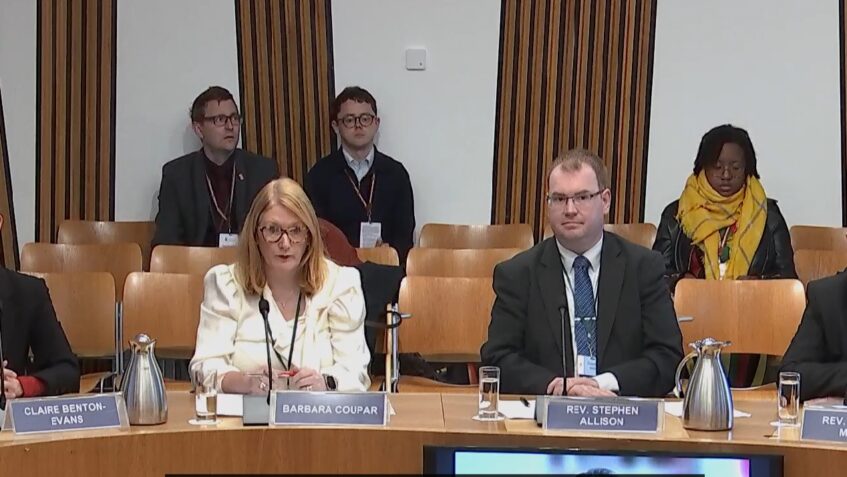
Barbara Coupar, Director of the Scottish Catholic Education Service (SCES), was giving evidence to the Committee on the Children (Withdrawal from Religious Education and Amendment of UNCRC Compatibility Duty) (Scotland) Bill, alongside representatives of the Church of Scotland, Scottish Episcopal Church, Free Church of Scotland, and the Jewish Council of Scotland.
Under the Education (Scotland) Act 1980 parents can withdraw a child from religious education (RE) and religious observance (RO) in school. Religious education is also known as religious and moral education (RME).
Part 1 of the Bill would require schools to inform a child if their parent asks for them to be withdrawn from either or both of these. It also gives the child the chance to express their views. Where the child’s views are different from the parent’s views, the school would have to follow the child’s wishes. Where a child is not capable of forming a view, the school would not have to take these steps. However, it is assumed that a child is able to do so unless it is shown otherwise.
Part 2 of the Bill makes changes to the United Nations Convention on the Rights of the Child (Incorporation) (Scotland) Act 2024. This Act places a duty on public authorities not to act in a way that is incompatible with the UNCRC. There is an exception to that duty where an Act of the UK Parliament requires them to act differently. The Bill would put in place another exception so that Acts of the Scottish Parliament were treated in a similar way to Acts of the UK Parliament, where there are conflicting duties.
Witnesses told the committee that the number of pupils being withdrawn from RE/RO was very small, with Barbara Coupar adding that withdrawal tends to be by pupils from other faiths rather than those of no faith.
Several witnesses expressed concerns about the impact of the Bill on the rights of parents as first educators of their children, including Barbara Coupar, who is worried that the state could become arbiter in family disagreements, adding that schools “should not be put in a position where they are some sort of named person who is making decisions on behalf of the child instead of their family.”
Witnesses also lamented the negative impact on schools of another layer of bureaucracy and the introduction of an adversarial piece of legislation.
Barbara Coupar told the committee that Catholic schools already have experience of dealing with the small number of challenging situations that arise in relation to RE/RO, saying that, if a disagreement does arise in a Catholic school, the situation is dealt with “professionally, sensitively on a one-to-one basis, to ensure that the child’s views are heard and understood.”
In written evidence, SCES told the committee that RE and RO in Catholic schools are “always planned and delivered inclusively, with respect for pupils of all faiths and none”.
The committee will also take evidence from the National Secular Society and Humanist Society of Scotland before the Bill is debated and voted on by all MSPs.
You can watch the evidence session here: Equalities, Human Rights and Civil Justice Committee | Scottish Parliament TV